
By Randy and Debbie Stroman
Most couples do not stand at the altar dreaming of survival.
They dream of partnership. They dream of friendship. They dream of growing old together while building a life they both love. They imagine laughter around the dinner table, meaningful conversations late into the evening, shared victories, and a relationship that becomes stronger with every passing year.
Yet somewhere between the wedding day and today, many couples discover that marriage is harder than they expected.
The excitement of the early years is often replaced by responsibilities, bills, children, careers, disappointments, misunderstandings, and wounds that were never fully healed. The relationship that once felt effortless can begin feeling strained. Conversations become shorter. Defenses become stronger. The distance between two people can grow so gradually that neither realizes how far apart they have drifted until they wake up one day wondering what happened.
For some couples, the pain is obvious. There has been betrayal, dishonesty, constant conflict, or years of unresolved hurt. For others, the problem is more subtle. Nothing is terribly wrong, but something is missing. The friendship has weakened. The connection feels shallow. They are living together but no longer truly sharing life together.
When that happens, many couples begin believing a dangerous lie. They assume that what they are experiencing now is how the story will always be. The Book of Ruth reminds us that God often does His greatest work when people around you believe the story is over.
At first glance, Ruth appears to be a beautiful love story. In reality, it is a story about redemption. It is a story about how God restores what appears lost, rebuilds what seems broken, and creates a future where people can only see disappointment. For couples struggling in their marriage, the story of Ruth offers a powerful reminder that the chapter you are living today does not have to determine how the story ends.
Ruth’s story begins not with romance but with heartbreak.
Naomi had lost nearly everything. Her husband was gone. Her sons were gone. The future she once imagined had disappeared. The dreams she carried had been buried beneath grief and disappointment. So deep was her pain that when she returned home, she told people not to call her Naomi anymore.
“Do not call me Naomi; call me Mara, for the Almighty has dealt very bitterly with me.” (Ruth 1:20 ESV)
Many marriages reach a similar place. Perhaps there was no funeral, but trust, friendship, communication, and hope have died. The vision two people once shared slowly faded beneath years of conflict, disappointment, neglect, or emotional exhaustion. The marriage may still exist on paper, but the relationship feels very different than it once did.
Like Naomi, many spouses quietly conclude that their best days are behind them. What makes Naomi’s story so powerful is that she could not see what God was already doing. While she focused on what she had lost, God was preparing what she would eventually gain.
That truth matters because many couples make the same mistake. They judge their future based on their current circumstances. They assume today’s pain predicts tomorrow’s outcome. They believe the difficulties they are experiencing now are permanent.
But God specializes in working behind the scenes long before we recognize His hand.
One of the most remarkable moments in the story occurs when Ruth makes a decision that seems insignificant at the time but ultimately changes everything. After Naomi encourages her daughters-in-law to return to their families of origin, Ruth refuses. Instead, she makes one of the most beautiful declarations of commitment found anywhere in Scripture:
“For where you go, I will go, and where you lodge, I will lodge. Your people shall be my people, and your God my God.” (Ruth 1:16 ESV)
What is striking about Ruth’s decision is that she had no guarantee of a better future. She did not know she would meet Boaz. She did not know she would eventually marry. She did not know she would become part of the lineage of King David and ultimately Jesus Christ.
She simply chose faithfulness. That is often how redemption begins in marriage.
Most couples want a breakthrough. They want immediate change. They want the conflict resolved, trust restored, communication repaired, and the pain removed. But God often begins the process differently. Redemption frequently starts with one faithful step taken before the outcome is visible.
A husband chooses to listen instead of preparing his defense. A wife chooses to extend grace instead of keeping score. One spouse decides to apologize without demanding an apology in return. A couple agrees to seek help before resentment becomes permanent.
These moments may appear small, but throughout Scripture God repeatedly uses small acts of obedience to create extraordinary outcomes. Ruth’s decision to remain with Naomi seemed ordinary at that moment. Looking back, it became the turning point of the entire story. As Ruth faithfully cared for Naomi, God quietly began arranging circumstances she could never have orchestrated herself.
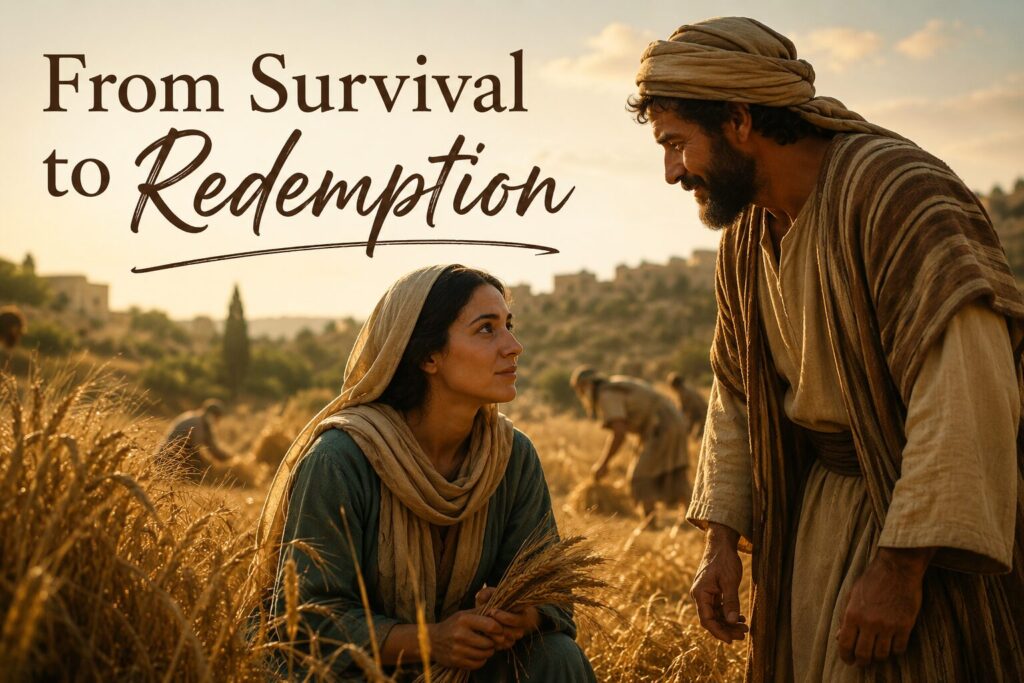
One day she found herself working in a field owned by a man named Boaz. The text almost makes it sound accidental. To Ruth, it likely appeared to be another ordinary day. Another field. Another opportunity to gather grain and provide for Naomi. Yet God was already weaving together a story that neither Ruth nor Naomi could yet understand.
How often does God work that way in marriage?
Couples frequently focus on what they can see—the disagreement they had last night, the tension that exists today, the wounds that remain unresolved. Meanwhile, God is often working in places they cannot see. He is softening hearts, exposing unhealthy patterns, and creating opportunities for healing. He is teaching lessons that will eventually strengthen the relationship.
The challenge is that God’s work often unfolds more slowly than we would prefer. We want immediate transformation, but God is building lasting transformation.
As the story continues, we see why Boaz becomes such an important figure. He was a man known for integrity, generosity, kindness, and honor. He noticed Ruth not because she demanded attention but because her character stood out. He had heard about her faithfulness to Naomi. He had seen her willingness to work hard. He recognized qualities that reflected God’s heart.
Likewise, Ruth noticed something different about Boaz. He treated people with dignity. He used his influence to protect rather than control. He demonstrated compassion without seeking recognition. Long before they became husband and wife, both Ruth and Boaz were developing the character that would eventually support a healthy relationship.
This is where many struggling marriages encounter an important truth.
Couples often spend enormous amounts of energy trying to change each other while giving little attention to their own growth. Yet the strongest marriages are not built by two perfect people finding one another. They are built by two imperfect people continually allowing God to shape their hearts.
The marriage you desire tomorrow is often connected to the person you choose to become today.
As Boaz and Ruth’s story unfolds, another powerful theme emerges: kindness. Their relationship was built upon consistent acts of kindness, honor, and respect. Neither person approached the relationship asking, “What can I get?” Instead, they continually demonstrated concern for others. Ruth cared for Naomi. Boaz cared for Ruth. Their actions reflected hearts that had learned to serve rather than simply being served.
Many marriages suffer because kindness has quietly disappeared. Not because love is gone, but because the daily expressions of love have faded. Encouragement becomes criticism. Patience becomes frustration. Understanding becomes assumption. The relationship becomes focused on what each spouse is not receiving instead of what each spouse can give.
Yet kindness has an extraordinary ability to change the atmosphere of a marriage. A gentle response can calm a heated conversation. A sincere compliment can rebuild confidence. A thoughtful act of service can communicate love more effectively than a hundred promises. Often the path toward restoration begins not with dramatic gestures but with small daily choices to treat one another with honor.
Eventually, the story reaches its defining moment. Boaz becomes Ruth’s kinsman-redeemer.
In ancient Israel, a redeemer stepped into a situation marked by loss and provided restoration, protection, and a future. Boaz willingly accepted that responsibility. He redeemed what had been lost and gave Ruth and Naomi a future they could never have secured on their own.
The entire story points toward a much greater Redeemer. Jesus Christ does for us what Boaz did for Ruth. He steps into broken situations and brings restoration. He steps into hopeless circumstances and creates hope. He steps into loss and offers redemption.
That truth applies not only to individuals but also to marriages. Every marriage experiences moments of weakness. Every marriage experiences failure. Every marriage contains seasons where disappointment threatens to overshadow hope. Yet the Gospel itself is a story of redemption. The same God who redeems people is fully capable of redeeming relationships.
The enemy wants couples to believe that too much damage has been done. God says redemption is still possible. The enemy wants couples to focus on their failures. God invites them to focus on His grace. The enemy wants couples convinced that nothing can change. God specializes in changing what appears impossible.
By the end of the Book of Ruth, the story looks nothing like it did at the beginning. The woman who once believed her future was finished is holding new life in her arms. The bitterness that once defined her perspective has been replaced by joy. The loss that once seemed overwhelming has been overshadowed by restoration. Most importantly, Naomi discovers that what she believed was the end of the story was actually only the middle.
The most powerful thing about this redemption story is God used the marriage of Ruth and Boaz to establish the lineage of King David and ultimately Jesus Christ. Now that is redemption out of a survival story.
That may be the greatest lesson Ruth offers every struggling marriage. The chapter you are living today is not necessarily the end. The big argument is not the final chapter. Your disappointment is not your destiny. Betrayal and loneliness do not have to define you. Your season of distance is not permanent. God has been writing redemption stories since the beginning of time, and He has not stopped. If you let Him, He will redeem you as well.
If your marriage is struggling today, do not make the mistake Naomi almost made. Do not assume that because the present is painful, the future is hopeless. Do not assume that because restoration has not happened yet, it never will.
Instead, take the next faithful step. Choose kindness instead of bitterness and honesty over deceit. Choose humility over greed and forgiveness over judgment. Choose prayer over worry and faithfulness over giving up. Trust that the God who redeemed Naomi’s future, restored Ruth’s life, and blessed the union of Ruth and Boaz is still able to redeem marriages today.
Because the marriage God envisioned when you stood at the altar is not gone. It is waiting for two people willing to trust Him with the next chapter of their lives together.
There Is Still Hope
If your marriage feels stuck, disconnected, or overwhelmed by unresolved issues, we would be honored to help.
At Your Great Marriage, we have spent decades helping couples move from conflict and confusion toward healing, unity, and hope.
Schedule a complimentary 10-Minute Connection Call and let’s talk about what restoration could look like for your marriage.
Website: https://yourgreatmarriage.help
Email: help@yourgreatmarriage.help
Because no matter how difficult things may seem today, God is still writing redemption stories.